The HUMAN AI Method,
Step by Step
Every phase. Every step. No guessing about what happens next.The HUMAN AI Method (written H.U.M.A.N. for its five phases) is our standard for workflow documentation and SOP automation. It maps how your business actually runs before anything gets automated.
See the video belowThe Mechanism Behind the Method
What we actually do at every stage, and why the order mattersThis is the real mechanism behind the H.U.M.A.N. AI Method: every phase, every step, and the standard we use to document your workflow before and after automation. Done right, it leaves your business more efficient, often less expensive to run, and able to grow revenue with the same team you already have.
Skip a step, and the risk shows up fast. AI just makes an already inefficient process faster. Your most valued people push back instead of buying in. Or the system works fine at launch and then quietly breaks or goes stale without ongoing oversight.
Download the Full Methodology (PDF)How We Document Every Step
Applied to your current process, and again to the future oneStep
The action's name
What
What happens
Where
System or location
Why
What breaks if skipped
How
Tool, person, or method
Next
What triggers the next step
Discovery & Buy-In
Get the truth about how work actually happens, and get your people on board before anything is designed.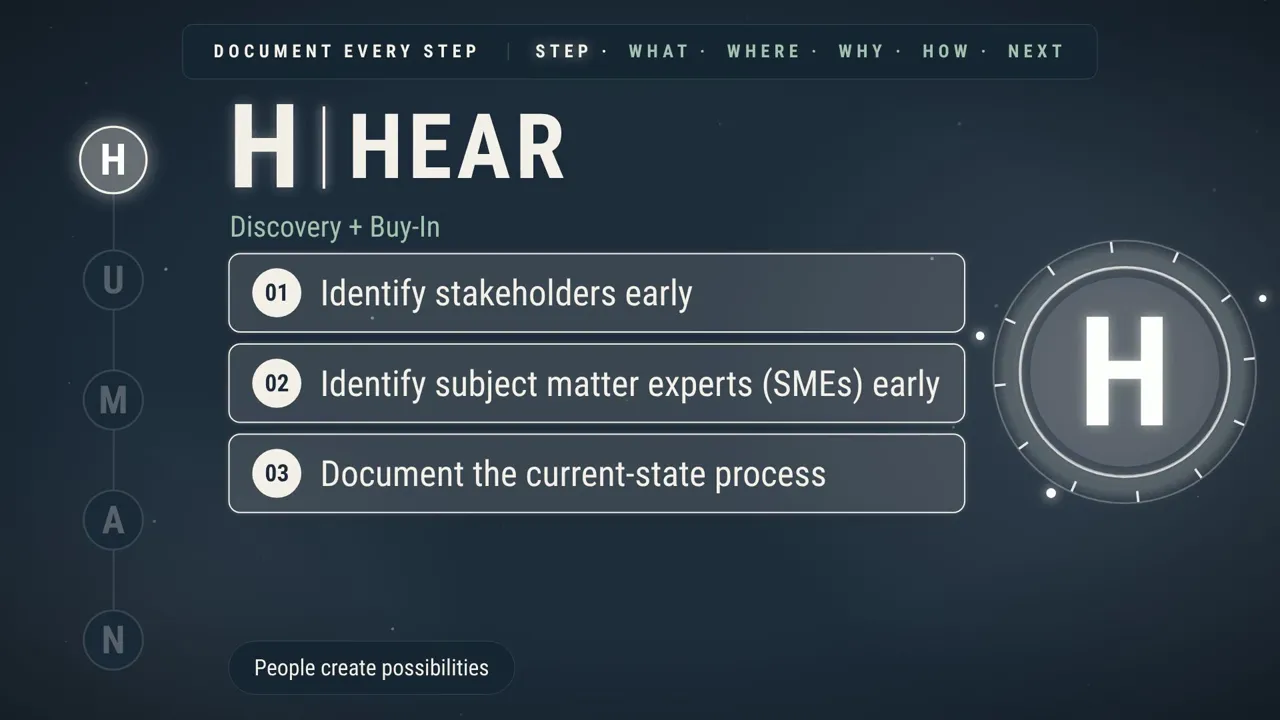
Identify Stakeholders Early
We start with the people who control budget and priorities. They tell us what success actually looks like, and their sign-off up front means a finished system never gets killed by someone who was never consulted.
Identify SMEs Early
Then we talk to the people doing the work every day, not their manager's version of it. Bringing them in from day one turns "AI is replacing me" into "I helped build this."
Document the Current-State Process
We walk your entire workflow start to finish, using the same six-field standard on every step. No skipping the obvious ones. That's usually where the exceptions live.
Analysis
Decide what to keep, kill, or automate, with the people doing the work, not around them.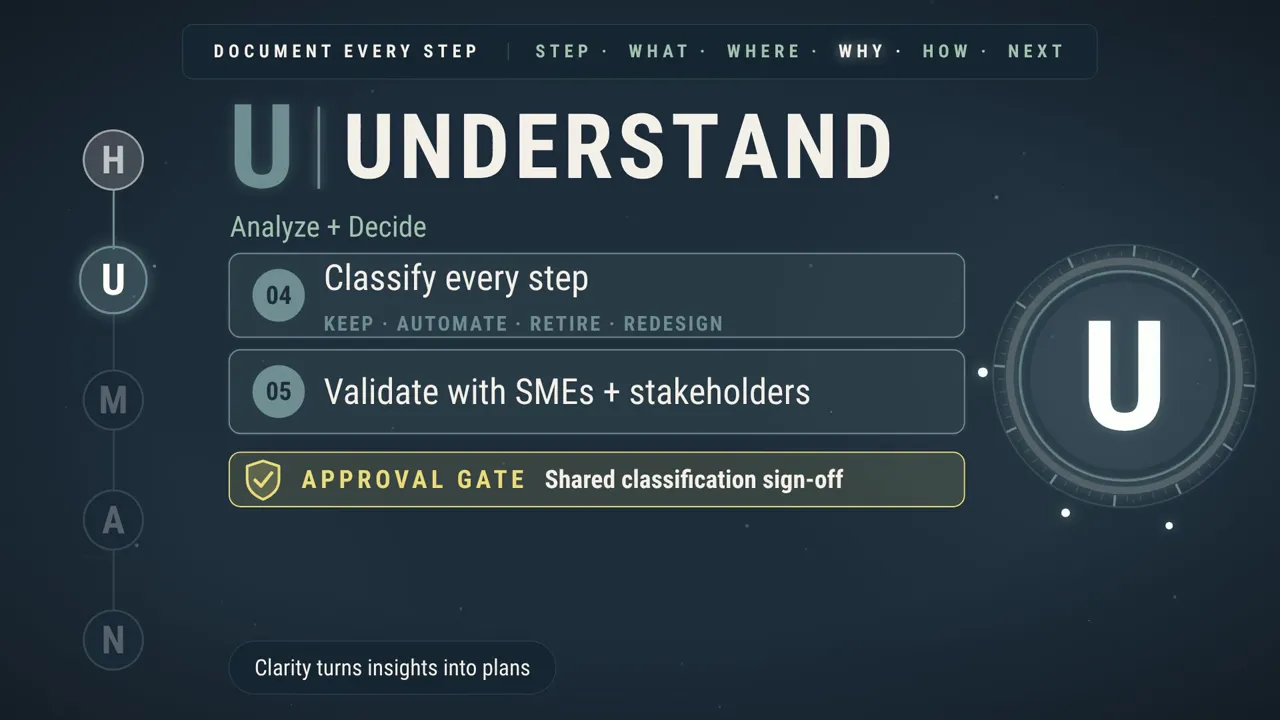
Classify Every Step
Every step gets tagged: keep as-is, automate, retire, or redesign. Automating a wasteful step just makes the waste faster, so we deal with that first.
Validate With SMEs & Stakeholders
We review that classification together, out loud, so nothing gets automated or retired as a surprise to the people it affects.
Design
Design the future-state workflow so it's explicit what the system does versus what a person still does.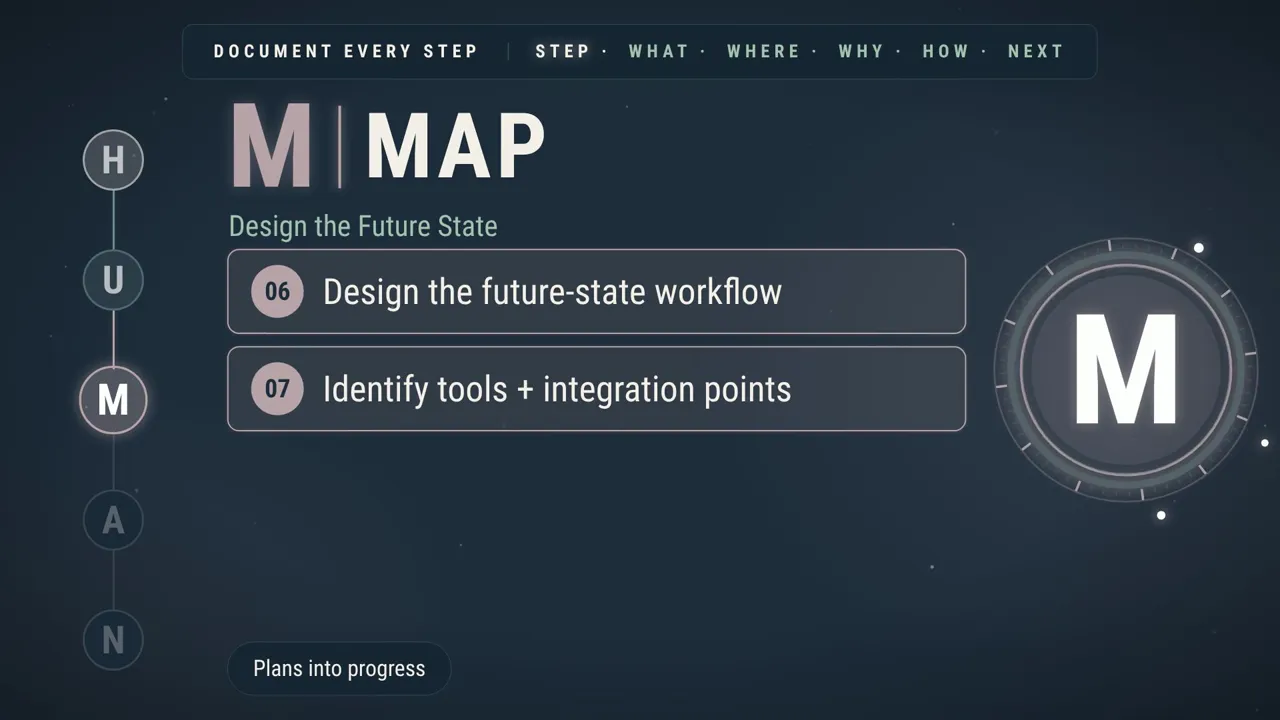
Design the Future-State Workflow
Same six-field standard, but now it shows what the system handles and what a person still owns.
Identify Tools & Integration Points
We name the actual stack for every handoff, like GHL, N8N, Supabase, or the Claude API, because that's exactly where automations quietly break later.
Build, Document, Train, Test
Build it, document it, train the people who'll run it, and prove it works before it goes live.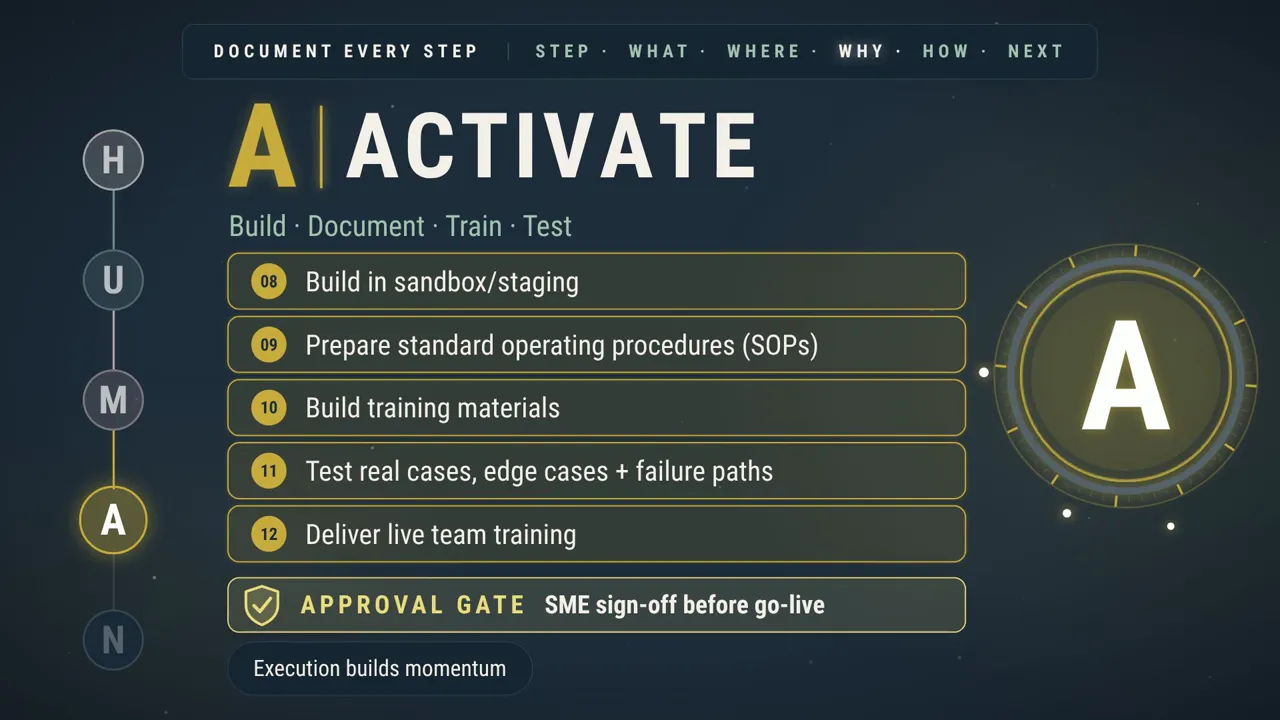
Build the Automation
Built and tested in a sandbox first. We never build directly against your live data.
Prepare SOPs
Written procedures for both halves of the new process: what the system does on its own, and what a person still has to do. If it's not written down, it depends on one person remembering it.
Build Training Materials
Recordings, quick-reference guides, and an FAQ built from the real questions your team raised in the first two phases.
Test the System
Run against a real record or contact, including the edge cases and failure paths, before anyone gets trained on it.
Deliver Training
A live walkthrough with your team on the tested, working system, not just a document handed off and forgotten.
Maintain & Evolve
Keep the system accurate, working efficiently, and current. This is the phase most businesses skip, and why automations quietly rot.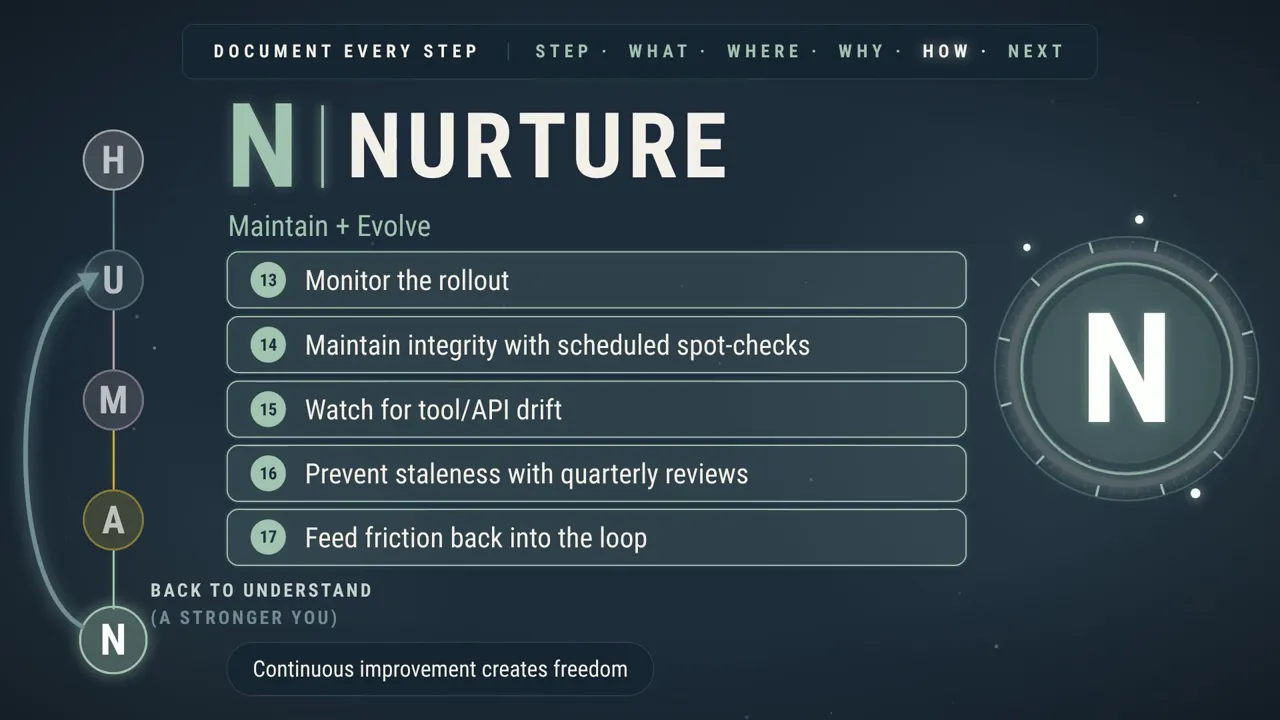
Monitored Rollout
We watch the first real runs closely. Passing a test isn't the same as working live.
Maintain Integrity
Scheduled spot-checks compare what the system produced against what it should have, on a set cadence, not just when someone complains.
Watch for Tool & API Drift
Vendors like GHL, N8N, Zapier, and Claude change their platforms without warning. One named person checks for breaking changes on a schedule, not after something fails.
Prevent Staleness
A quarterly review confirms the process still matches how your business actually runs today.
Feed Friction Back Into the Loop
Whatever your team finds annoying or wrong goes straight back into Step 4's classification. That's what makes this a system instead of a one-time project.
What Each Skipped Phase Costs
Skip Hear, and the system won't match how your business actually runs, and your team will resent it. Skip Understand, and you've automated waste instead of removing it. Skip the SOPs and training in Activate, and it works until the one person who understands it leaves. Skip Nurture, and it breaks quietly the first time a vendor changes their API, and nobody notices until it's already cost you something.